|
Use
this sailboat database every time you need to determine your sailboat's sail
area.
-
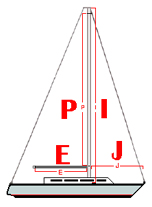
I = Height of headstay
termination above the sheer line
- J = Distance between
headstay termination at deck and front of mast at the
sheer line.
- P = Distance between
black bands on the mast, or the maximum luff length of the main.
- E = Distance between
black bands on the boom, or the maximum foot length of the main
- PY & EY are similar to
P & E, but indicate mizzen dimensions
- Fore-mast - the first
mast, or the main-mast
- Main-mast - the
tallest mast of the ship
- Mizzen-mast - The mast
immediately aft of the main-mast
- Jigger-mast - the
fourth mast
Sailboat Rigging Types
Sailboat rigging types vary and refers to the ropes or
cables that support the masts and adjust the sails. The term may also
refer to the formation of masts and sails on a ship.
We will describe the the five most common sailboat
rigging types referred to as, the formation of the mast and sails, on a
ship.
-
Fractional rig:
A fractional rig on a sailing vessel consists of a foresail, such as a
jib or Genoa sail, that does not reach all the way to the top of the
mast.
-
Sloop rig:
sloops are designed to optimize upwind sailing. However, sloops also
offer an excellent overall compromise acceptable, if not optimal, to all
points of sail.
-
Bermuda rig:
The rig consists of a triangular sail set aft of the mast with its head
raised to the top of the mast; its Luff runs down the mast and is
normally attached to it for its entire length; its tack is attached at
the base of the mast; its foot controlled by a boom; and its clew
attached to the aft end of the boom, which is controlled by its sheet.
-
Gaff rig: Gaff rig
is a sailing rig (configuration of sails) in which a
sail is a four-cornered fore-and-aft rigged item
controlled at its peak and, usually, its entire head by
a spar (pole) called the gaff.
-
Mast aft rig:
A mast aft rig is a sailboat sail-plan that uses a
single mast set in the aft half of the hull to support a
jib or multiple staysails, with either a small or
completely absent mainsail.
The Mast
-
Fore-mast: the
first mast, or the mast fore of the main-mast.
-
Main-mast: the
tallest mast, usually located near the center of the
ship.
-
Mizzen-mast: the
third mast, or the mast immediately aft of the
main-mast. Typically shorter than the fore-mast.
In the 1930s aluminium masts were
introduced on large J-class yachts. An aluminium mast has
considerable advantages over a wooden one : it is lighter
and slimmmr than a wooden one of the same strength, is
impervious to rot, and can be produced as a single extruded
length. After the Second World War, extruded aluminium masts
became common on all dinghies and smaller yachts. Higher
performance yachts would use tapered aluminium masts,
constructed by removing a triangular strip of aluminium
along the length of the mast and then closing and welding
the gap.
From the mid 1990s racing yachts
introduced the use of carbon fibre and other composite
materials to construct masts with even better
strength-to-weight ratios. Carbon fibre masts could also be
constructed with more precisely engineered aerodynamic
profiles.
Sails
Sails are fabric aerofoils designed to
catch the wind and manipulate the air currents surrounding
the vessel. They are attached to spars and rigging in
various ways, such as metal clips, rope hoops, or in a luff-groove.
Sails are usually rectangular or triangular in shape, which
determines their use and placement.
Sails are classified according to their
shape and location. The name of a sail on a square-rigged
vessel with multiple masts consists of the mast name and the
sail's vertical position. On a three-masted vessel the masts
are, from bow to stern, Fore, Main and Mizzen; the "plain"
square sails are, bottom to top, Course, Topsail,
Topgallant, Royal and Sky. Thus the sail second up the
mizzen-mast is the "mizzen topsail", and the third sail up
the fore-mast is the "fore topgallant sail". Sails set in
other positions, or only in special circumstances, have a
variety of other names for instance: a triangular sail set
on a stay might be called a staysail, or jib if the stay in
question runs to the prow or bowsprit; sails set either side
of square sails to increase sail area in light winds are
called studding-sails, qualified by the side and the plain
sail name (such as "port topgallant studding-sail", but more
likely to be pronounced "port t'ga'ant stun'sl"); a gaff
sail set aft of the mizzen mast may be called a Spanker or
Driver.
|